Thursday, 7 September 2017

Intermission

My new novella is now available as a Kindle download and a paperback. It’s called ‘Temporary Accommodation’. Here’s the blurb:
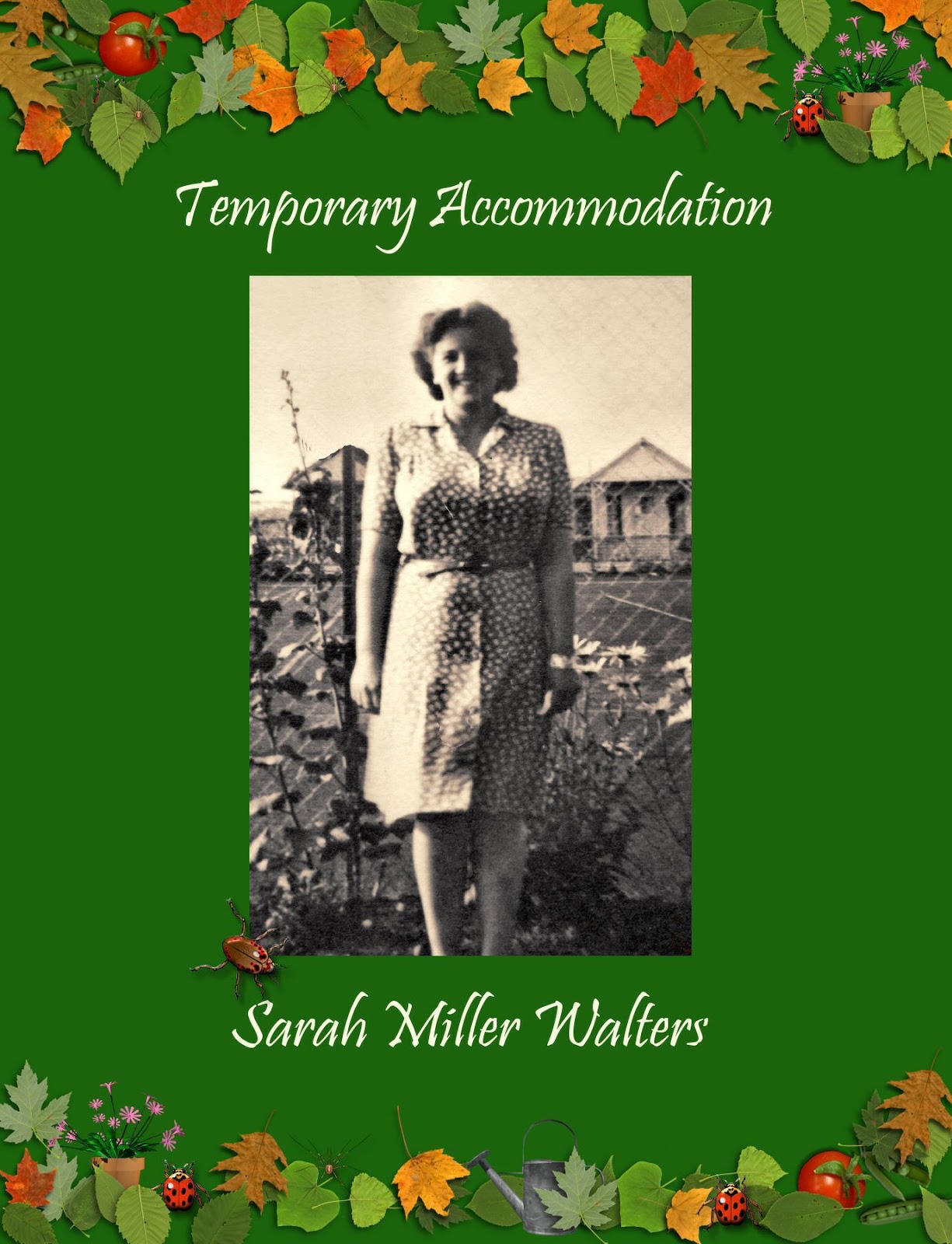


It is the late 1940s and Old Vic Theatre trained actress Marigold Walbrook is languishing in a suburban repertory theatre. Having lost her home and parents in a V2 attack, her landlady is the nearest she has to a family. When Marigold's half-forgotten and reclusive Great Aunt dies, she inherits Donkey End Cottage in the Hampshire town of Bishop's Wallop. Deciding to abandon her acting career, she takes up residence in the cottage, planning to become a playwright.

Marigold finds that the residents of Bishop's Wallop are preoccupied with a new development of prefab houses that are being built in a field near to Marigold's cottage. They are intended to house bombed-out families from Portsmouth. Locals are worried that this influx will spoil their little town and their quiet rural lives. Knowing what it is to be homeless, Marigold determines to do something to bring together the old and new residents. As it looks increasingly likely that gardening will take over her life, she decides to launch a gardening competition, with prizes to be awarded by an old acting friend at a summer garden party. The competition meets many obstacles along the way, including the might of the local Women's Institute. But with a small group of new friends and her old landlady, she digs deep to build a community.

This novella will appeal to those interested in post war life in Britain. With reference to films, acting stars, prefabs and rationing (and a cameo appearance from Thorley Walters) it evokes a different and difficult time in our history with humour and warmth.


Twitter: @agathadascoyne
Instagram: @Adventureswithword

Wednesday, 30 August 2017

Spotlight on St Trinians 13

Britain in the Time of St Trinians – Culture

A glimpse into what else was happening in the realm of books, films and theatre in the year that ‘The Belles of St Trinians’ was released (1954).

Other cinematic releases and their stars:

·        Doctor in the House (Dirk Bogarde)
·        Eight O’Clock Walk (Richard Attenborough)
·        An Inspector Calls (Alistair Sim)
·        The Maggie (Paul Douglas)
·        The Weak and the Wicked (Glynis Johns)

New books published:

·        Lord of the Flies (Golding)
·        Lucky Jim (Amis)
·        Live and Let Die (Fleming)
·        Bonjour Tristesse (Sagan)

New plays produced:

·        Separate Tables (Rattigan)
·        Sailor Beware! (King and Cary)
·        The Burning Glass (Morgan)
·        The Dark is Light Enough (Fry)

·        Spider’s Web (Christie)


Thursday, 10 August 2017

Spotlight on St Trinians 12

The History of Flash Harry

George Cole was born in South London in 1925, but was abandoned by his natural mother and adopted by the Cole family. They were not well off, and George joined the acting profession as a means of escaping a life of drudgery. This upbringing in downtown Tooting served him well – he specialised in playing the kind of character that dodges and cheats his way out of trouble or into a bit of cash. No doubt he came into contact with several people like this as he was growing up. In the 1950s, if the role called for a spiv, George Cole was called in. For a great example of this, see the 1955 film ‘Where There’s a Will’.


George was 29 years old when he first played the role of Flash Harry, and he stuck with this character longer than Alastair Sim or Joyce Grenfell stuck with theirs. I get the feeling that this was more for financial reasons than dedication – he wasn’t hugely famous and handsomely paid.  Every role is a gift to a jobbing actor who is worried about falling back into the poverty he once knew.


In a television interview given to Michael Aspel in the 1980s, George acknowledges the direct line travelling from Flash Harry to Arthur Daley, his most famous spiv role of all. And he is on record as stating that although Arthur Daley served him well, he personally found him an abhorrent character, pitying anyone who has someone like him as a husband or father.  You could say the same about Flash Harry. Flash is a funny character – as long as you don’t analyse his actions. If this sort of person was to appear on screen today, there would be questions asked. On paper, he is a sleaze - hanging around a girls’ school, selling on their contraband and arranging lucrative weddings for the sixth formers. But of course, in a film from times that are considered to be more innocent and with the loveable George Cole in the part, you have to like him. When you hear that lopsided music hall tune and see the shrubbery tremble, you know you’re in for a chuckle.


I recently wrote a blog on some of my film and theatre favourites for the delightful Carry on Blogging – have a look here:


Wednesday, 26 July 2017

Spotlight on St Trinians 11

In Flagrante Delicto. Again.

Back in 2012 I wrote a History Usherette blogpost on ‘The Belles of St Trinians’. I gave it the title ‘In Flagrante Delicto’ and it got an increased amount of page views than was usual. This, I concluded, had to be down to the cheeky title. I called it this because it is the St Trinians school motto – as shown in a scene in the film. Strictly translated from the Latin, this motto means ‘In blazing offence’ or to give it a more straightforward meaning ‘caught in the act’. The more cheeky aspect of this phrase related to divorce cases – it was a coy legal term to state that one of the parties to the divorce had been caught in the physical act of adultery. This was in the days where, if you wanted a divorce, you had to demonstrate adultery - whether it had actually been committed or not. People were often paid to pretend that they’d seen you at it; or to be a fictional third party.

But the original Latin term led me to muse on the theme of arson in the St Trinians films. It is the catalyst for two of Alastair Sim’s best lines in ‘Belles’. Firstly, when Miss Fritton’s niece is threatened with expulsion for burning down the Sports Pavilion and the young lady complains that the girl who burned down the Gym wasn’t punished:
“The Gym was insured, the Sports Pavilion was not.”
And then:
“I WILL NOT have continual arson in my school!”


Then of course, ‘Pure Hell’ begins with the schoolgirls on trial for burning down the school, where they are eventually acquitted of arson. Why did Launder and Gilliat repeat this motif? I suppose it is because fire is the ultimate destructor. In the 1950s, little girls were meant to be anything but destructive. The female was meant to be nurturer, creator. The most outrageous thing contrary to this is to depict them as a wilfully destructive bunch, using fire to achieve their desired outcomes. I wonder if this was a little bit shocking to contemporary audiences? Did Launder and Gilliat use the motif to grab attention for their films? Was this their feminism coming to the fore again, showing the metaphorical lengths that girls had to go to in order to escape their prescribed role in society?


Do visit my new Instagram account @Adventureswithword

Wednesday, 5 July 2017

Spotlight on St Trinians 10

The History of Ruby Gates

Joyce Grenfell was born in 1910 and was therefore 44 years old on her first St Trinians outing.  In ‘Belles’ she played the local police sergeant, Ruby Gates, who was sent to work at the school undercover. Her “teacher” name, given to her under protest, was Chloe Crawley (“But they’ll call me Creepy Crawley!”). Parallel to the main story, we learn about Ruby and her long term engagement to the less than enthusiastic Superintendent Kemp-Bird. Frankly, he uses her romantic adoration of him to get her to do his dirty work.

Creepy Crawley
Ruby Gates returned in two sequels – ‘Blue Murder’ then ‘Pure Hell’. In the first, she goes undercover again, this time on a school European bus tour where she and Terry-Thomas string each other along. In ‘Pure Hell’, she has to stow away on a lifeboat as some of the schoolgirls go on ‘a tour of the Greek Islands’. In this final outing she does get Kemp-Bird as far as the church…until news of further shenanigins at St Trinians reaches him just in the nick of time. Poor Ruby.

The character of Ruby Gates is endearing and also amusing. Old fashioned with a plummy turn of phrase, you root for the poor old girl even though she is not on the side of our St Trinians heroines. I think that this is a particularly clever trick, to be able to draw out our sympathy in this way. This is down to Joyce’s loveable talents. She patently liked people and was acutely observant, being able to poke fun at different types without being unkind. I suspect that Ruby is an amalgam of many women that Joyce had come across, particularly in her war work and through her attendance at Womens’ Institute meetings.

Just a crazy, mixed up policewoman
Joyce was born in London to an American mother and British/American father. Her mother was the sister of Nancy Astor and so Joyce was well connected yet not snobbish. In the early days of her marriage she was not rich and often depended on the kindness of her Aunt Nancy…who would then take advantage of this control to try and smother Joyce’s early forays onto the stage. But those monologues that she began with were soon in demand in revues and on the radio. Her career was cemented during World War Two as she tirelessly toured for ENSA, singing and reciting to troops in the Middle East and beyond. There were a few brief early film parts before St Trinians, most notably in ‘The Happiest Days of Your Life’ which took Joyce directly to the part of Ruby Gates.

I wrote a collection of short stories inspired by moments in Joyce's career - you can get them on Amazon here


Monday, 19 June 2017

Spotlight on St Trinians 9

Locating St Trinians

I’ve been looking at places where ‘Belles’ was filmed, thanks to websites such as the excellent Reel Streets. There are three stand out locations:

All Nations College, Easneye, Stanstead Abbots, Herts
Littleton Park House (Shepperton Studios), Middlesex
Great Dunmow, Essex

The first two locations stood in for the school itself, while Great Dunmow provided the location of the unfortunate nearby village.

All Nations College was previously known as Easneye mansion, and was built in the mid 19th century to a design by Alfred Waterhouse (also responsible for the Natural History Museum and the magnificent Manchester Town Hall). The mansion was commissioned by a brewing family called Buxton – one of whom was responsible for pushing the Emancipation of Slaves Bill through Parliament.
To me, the best bit is that the Buxtons popularised beer as a healthier alternative to gin…and then we see the St Trinians girls using the place to make their own moonshine!
 A familiar looking Lodge House - remember Ruby Gates galloping by?

Littleton Park House has a lengthier early history, being the home of local nobility dating back to the 17th Century. It is an integral part of Shepperton Studios and was therefore not a stranger to the camera back then – and it remains a photogenic backdrop today. The house was first involved in the embryonic industry in the 1930s, having being bought by a businessman for the sole purpose of making films. As an interesting aside, during World War Two the studio’s expertise in prop building was put to excellent use when it was commissioned to build dummy aircraft to baffle the Luftwaffe. These days, you can get married there, probably if you have lots of money…I bet Flash Harry’s behind that idea…an extension to his marriage bureau?


 Great Dunmow has a long and very British history. In the mid 20th Century there was a nearby airbase, used by both the RAF and the US Airforce. Seems rather a fitting location for Flash Harry and the Six Formers…

Back to school preparations...


Please have a look at my books...you might like them...

Thursday, 8 June 2017

Spotlight on St Trinians 8

The History of Miss Fritton

Alastair Sim was born in 1900, and so was 54 years old when headmistress Miss Fritton was gifted to the world in ‘The Belles of St Trinians.’ He also played her brother, Clarence Fritton and made a much reduced return in the 1957 sequel ‘Blue Murder at St Trinians’.  As Miss Fritton – and Clarence - Sim brings a wonderful air of genteel crookedness to delight us throughout the film. In terms of drag roles, nothing could ever surpass this one, in my opinion. Sim doesn’t pile on fake femininity, he remains the character actor that we love except with a string of pearls and a softer voice. We believe wholly in Miss Fritton as a female character, which is tribute to the talent behind her.


Sim began making films in the mid 1930s – a stalwart of the quota quickies. In 1936 he appeared in six films! As war broke out he was appearing in the ‘Inspector Hornleigh’ films, where he first came into contact with Launder and Gilliat. He was also a stage success – here’s a programme from the wartime play ‘Cottage to Let’ from my own collection. Note fellow St Trinians actors in the cast – George Cole and Thorley Walters.


Sim made his most memorable films in the post war years including the first of the Ealing comedies ‘Hue and Cry’ (1946). I recommend ‘The Green Man’, ‘The Happiest Days of Your Life’ and ‘Scrooge’. In 1954, the year of ‘Belles’, Sim also starred in the film of the fantastic JB Priestley play ‘An Inspector Calls’. Compare the two roles and marvel at his versatility.