Friday, 12 December 2014

Wisdom at Work

Norman Wisdom. Those two words could divide a nation.  Some can’t get enough of his simple-man slapstick humour.  Others find that his antics get right on their nerves.  Personally, I can go either way. It depends what sort of a mood I’m in and how irritated I feel with the world in general.  If I’m having a good day then I will laugh indulgently at his unusual approach to life.  If, however, the nerves are a bit frayed then eye-rolling and cheek puffing may set in after a bit. 

‘Trouble in Store’ (1953) is one of his earliest and better ones, made into a must-watch film by the presence of Margaret Rutherford.  She plays a kleptomaniac shoplifter, tottering around a department store and filling her suitcase with whatever takes her fancy. It’s not a big role for her but as usual she tackles it with relish and she is a total joy.  Wisdom plays a lowly stock room worker at the store, where he is repeatedly sacked and re-hired by the new boss.  His antics don’t get too annoying in this film – it’s well before all that daft Mr Grimsdale palaver and there are some genuinely very funny moments (the revolving door and the ice cream flick stand out for me). He does sing his “Don’t Laugh at Me” song (yawn) but at least this is interspersed with scenes of Esma Cannon heaping sugar into her tea, which makes the ordeal worthwhile.

Wisdom, by @aitchteee
There is a feeling of nostalgia in many of Wisdom’s films. For example, there’s the one where he’s a horse drawn milkman, fighting against the big conglomerate dairy company with their fancy electric floats (themselves now the object of nostalgia to us!). ‘Trouble in Store’ seemed to me to hark back to the good old days of retail.  The department store where he works, Burridges, is a very paternalistic company.  You get the impression that a job with them is a job for life, if you want it to be. In return for loyalty to the firm staff are given various small perks, such as a place to park their bikes and recreational facilities and events. The leader is visible and approachable – not some faceless suit in an office somewhere else.  Jobs like these have been dying out slowly over the past few decades.

I reflected as I watched  how attractive this workplace probably looks to those working in retail today. I recently spoke to an old acquaintance who works in a supermarket, one which prides itself on being cheaper than all the others.  Her actual hours are full time (or even more than full time as I see it) yet she is only on the books as part time, probably so she doesn’t get all of the working conditions associated with full time work – and so that they can drop her hours at a moment’s notice if they want to. She feels insecure and would leave if there was anywhere else to go. This is how they make their goods so cheap - on the backs of their staff.

A friend spoke to someone who works for a major department store.  They are not replacing staff who leave and this means that on Sunday mornings she now unhappily works alone on her floor.  Margaret Rutherford’s character would be very interested in that piece of information!  Zero hours contracts too are becoming more common, offering only insecurity to thousands of families.  These days, employers seem to take the attitude that you are lucky to find work of any kind.  There is some truth in that, but why use this as an excuse to treat your workers like another piece of stock?  These are probably the same employers that complain about the under educated workforce, not having heard the old adage about paying peanuts and getting monkeys. Where is the incentive to do better?


We may laugh at Norman’s original 1950s audience – weren’t we a simple people back then?  How unsophisticated we were to make this a box office hit. To think that this is what made us laugh then!  But if we were to go back in time and meet our grandparents 60 years ago; and tell them how we aspire to find a job in a place as good as Burridges, where your job was safe and your wellbeing taken care of, what would they think? When we told them about our Dickensian jobs, who would be the ones laughing then?


Friday, 28 November 2014

Frightful Frying

In my previous blog post I wrote about the British horror film, made popular by the Hammer Studios’ output from the 1950s onwards. There are two points which indicate just how popular they became.  Firstly, the sheer number of them that were turned out – Hammer made over 50 features in this genre.  But the second major indicator is the spoof tribute film, ‘Carry On Screaming’ (1966).  If the Carry On crew were prepared to give it a good send-up, then that is all the evidence you need for something being an established part of British culture.

‘Screaming’ is one of my favourites – Kenneth Williams is perfectly cast in the role of a mad Victorian doctor; with Fenella Fielding vamping it up admirably as his sister.  They are sending out werewolf – like creatures to abduct women and this is investigated by Harry H Corbett’s policeman. The underrated Peter Butterworth plays his assistant, providing many of the comedy highlights.  There are always many references to contemporary British culture in the Carry On films.  Even those set in a historical period make a point of sneaking in snide comments about modern Britain. My favourite example is in ‘Carry on up the Khyber’.  When Princess Jelhi reacts with horror to the news that the Khasi has decreed a “death by a thousand cuts”; he retorts “Nonsense!  The British are used to cuts!” A clear reference to contemporary government policies.
Dr Watt by @aitchteee

 ‘Screaming’ was recently shown again on the television and I caught the final chunk of it with my eldest daughter.  She asked me what was so funny about Kenneth Williams’ catchphrase – and also, what did it mean? “Frying tonight” is the phrase in question, called out gleefully as the kidnapped women are dunked in the bubbling vats in his lab.  I explained to her that this is how chip shops used to alert people to the fact that they were open and frying fish and chips that evening. She looked rather confused, and I realised that I was getting old. Of course we now live in a culture where fast food is always available at any time of the day or night. Macdonalds or KFC have no need to advertise that they are cooking – they just always are.  No wonder we’ve all got so fat; fast food is no longer a treat and it is viewed almost as a necessity.  The very idea that chip shops would advertise in this way now seems quaint.  So, it just goes to show, even in a film as far removed from reality as ‘Carry On Screaming’, it is possible to pick up a tiny gem of our lost culture, viewed from a world that most of the cast would no longer recognise. 


Now available as an Amazon Kindle download for 77p

Monday, 17 November 2014

Down on the Tube Station at Midnight

I’ve been writing this blog for over three years now, and lately I have pondered over the cinema genres that I may have neglected to cover.  Here in Britain we hosted the Hammer Studios, which in the latter half of the twentieth century turned out a string of well known horror films.  These films are held in high esteem by a great number of people – so why have I never got around to writing about one?  It’s perhaps because few of these films are grounded in any kind of reality.  When I think Hammer, I think of Christopher Lee in a Transylvanian castle; or improbable monsters in misty forests. Not a lot for the History Usherette to get at there, unfortunately.

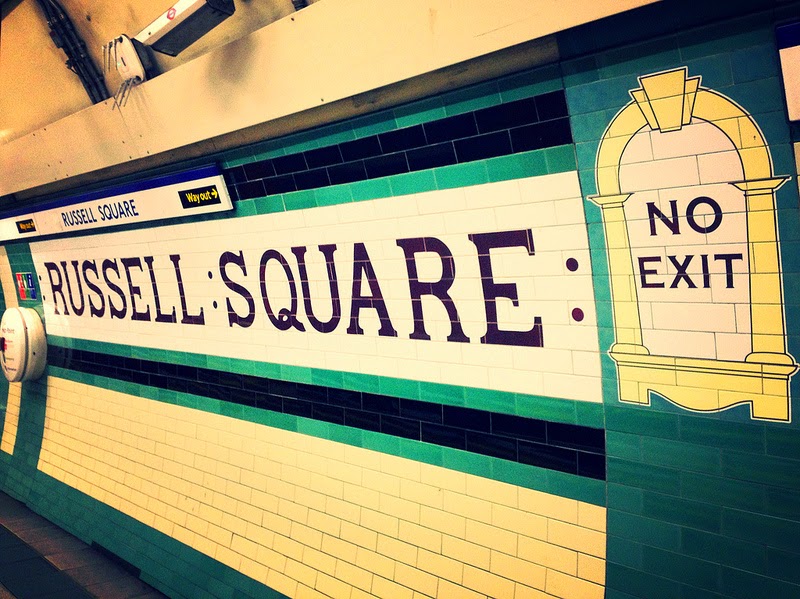
If you were to ask me which was my favourite horror film, it would not be one produced by Hammer.  It bears some of the hallmarks of one of their productions – 1970s technicolour goriness which doesn’t spare the blood.  Christopher Lee is even in it, albeit briefly in a pointless cameo role. I might have at one point assumed that it was one of theirs.  The film that I’m referring to is called ‘Death Line’ (1972).  It stars Donald Pleasance as a rather odd policeman who is investigating a series of mysterious happenings at Russell Square tube station in central London. A high profile man disappears; then a multiple murder is discovered and meanwhile an American student and his girlfriend become embroiled in the case, culminating in her disappearance.  We find out that the culprit is the descendant of some Victorian workers who were trapped in a tunnel collapse and then abandoned to their fate by an unscrupulous construction company. They survived by eating human flesh –their own people at first – but the final remaining descendant is now on the prowl for fresh meat.  Anyone who has ever seen the film will be nodding and smiling at my description– once seen it is never forgotten. This is mainly because the underground creature can only say one phrase of English – “Mind the doors” – and his use of it is both uproariously funny and deeply disturbing.  I’m not sure that it was meant to be so funny; but there are many people who have watched this in a state of intoxication and then spent the rest of the night shouting out the chilling catchphrase while chuckling gleefully.

The premise behind the film is, I suppose, not impossible yet not at all likely. This potentially makes a good horror film – something horrible that could happen but never has happened and never will. That element of potential reality makes the horror more piquant.  Also, its setting in a tube station really adds to this potential reality. Not only does it utilise a setting that is familiar to thousands of commuters, it plays on an iconic imagery which is familiar to millions.  A lot of people love the idea of the London Underground (probably mainly those who don’t have to use it every morning). The red and blue roundels are all over the lucrative tourist industry – I have a keyring and a fridge magnet myself. Mind you, I have those because they tell me to ‘Mind the Gap’ which reminds me of ‘Death Line’ and makes me smile. So part of the draw of the film is seeing how stations looked back in 1972 when they retained more of their original features than they do today. The tiling, the dark and winding corridors and the criss-cross metal doors are atmospheric. Russell Square station (although it was actually the now disused Aldwych that was used for filming) is almost another character in the film.  Best of all, one of the abandoned stations is depicted.  People are fascinated by these sealed up tombs of underground history – books have been written and photographs shared all over the place which pick over the obsolete parts of the network. The mock up of a closed Museum station is eerie in itself, without our cannibal traipsing through it howling in despair.


 At time of writing, it seems that there will also soon be another historical element to the film.  Much of the action takes place after the last tube train has gone through for the night and the station is closing.  Plans are afoot to bring in 24 hour working on the underground.  Perhaps we will soon look back on this wistfully, remembering when we had to run to catch the last train.  Remembering a time when things actually stopped for a bit and people got some rest.


I get the feeling that the writer and director of ‘Death Line’ really knew what they were doing. They produced a horror classic which is low-key enough to make you think that you have really made a discovery when you watch it.  But, I wonder, is Pleasance the star – or is it Russell Square station?


Thursday, 6 November 2014

Interlude Four

Now available as an Amazon Kindle download.

Download here.
Blackpool Rock

I was a glamour puss when I was young.  I grew up in Blackpool and there were always handsome boys passing through with money in their pockets.  That was all we thought about, all of my teenage summers.  I’d hang around the pier with my friends every Saturday afternoon, eyeing up the new intake of holiday makers, seeking out the boys who didn’t have a girl with them.  I spent days on end sat on the beach in my shorts and bathing costume, rubbing oil onto my legs, trying to look like that Coco Chanel.  I saved up for Woolworths make up and jewellery to finish the look off.  Sometimes I even got bits bought for me if I’d managed to pick up a really generous boy.  It’s amazing what a couple of hours under the pier after dark got you the next day.  Those were the best days.

It was while I was inbetween boys that I had my little encounter with fame. All the faces came up for the summer season, you’d see them wandering along the prom sometimes but you hardly ever got near them – they all had their hangers on. George Formby was a regular of course, and he always had his missus with him.  She was a rum ‘un that Beryl Formby.  Nobody ever dared cross her, least of all George himself.  I think she was born before her time, she would have made a good Dynasty type – all shoulder pads and ball breaking or whatever it is.  Joan Collins, you know what I mean.

Well one day I was laid out on a rock at the far end of the beach, just soaking up the last drops of the sun.  I heard somebody shuffle past me and I looked up to see a bloke in a jacket and hat sitting himself down on a boulder nearby.  I could tell by the way that his shoulders were hunched that he was feeling fed up so I called out to him, asking if he was alright.  He turned round and bless me if it wasn’t George himself.  I invited him to come and sit by me and tell me his troubles – and he did!  He was ever so fed up of Beryl, she’d been laying down the law at him and not letting him alone and he’d run away from her.  Just for half an hour, he said, just to show her what was what.  Then we had a bit of a canoodle behind his boulder.  I promised not to tell but I suppose it’s alright now.  They’re both long gone.  He left me a little souvenir but I won’t say what that was.


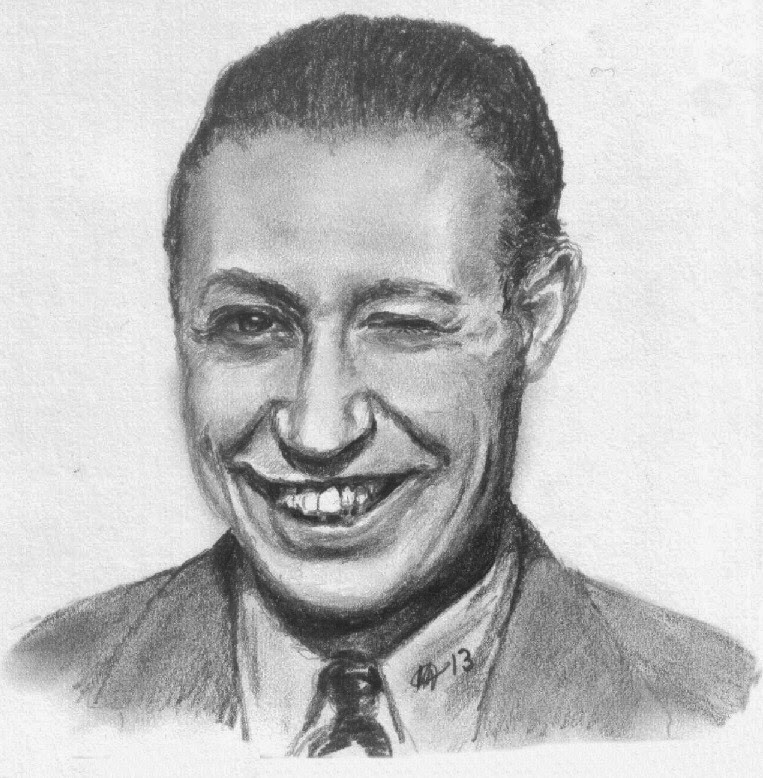
George by @aitchteee


Monday, 20 October 2014

Naked Exploitation

‘The Naked Truth’ (1957) is one of those films which is absolutely peppered with familiar film faces.  It stars Terry-Thomas, Peter Sellers, Dennis Price, Peggy Mount, Joan Sims and Shirley Eaton.  Miles Malleson is there too, doing his inevitable absent-minded clergyman.  I had never seen it before so was glad to be directed to the You Tube link on Twitter (thanks @trevor_hancock).  I found it an absolute joy to watch – particularly the double act of Mount and Sims as mother and daughter, who made the most of some terrific farcical material.

Joanie by @aitchteee

The storyline of the film revolves around blackmail and attempted murder – all handled in the typically British whimsical style of the period. Price plays Nigel Dennis, a blackmailing journalist doing the rounds of London’s powerful and famous with his new publication.  This magazine, titled after the film, threatens to expose the unsavoury deeds of those that he visits, unless they cough up £10,000, on receipt of which he will withdraw publication. As the film opens, the first recipient of a visit from Dennis shoots himself, while an MP has a heart attack in the Commons following his confrontation.  But then we move on to the stars of the film – who are obviously not going to top themselves just after the opening credits.  Having said that, Peggy Mount, playing novelist Flora Ransom, makes a comically failed attempt to throw herself out of the window.  Shirley Eaton, playing model Melissa Right also attempts to gas herself in the oven.  However, after messing about finding a shilling for the meter, her boyfriend turns up and stops her.  His lighting of a cigarette almost wipes them both out, but they survive the blast. Dennis also visits dodgy peer Lord Mayley (Thomas) and entertainer Sonny MacGregor (Sellers) who both decide to put up a fight rather than take the easy way out.

Of course, what we all want to know is what exactly the characters have been up to.  We want the salacious details, but we don’t always get them. I tried to read something into this about the times that the film was born of.  Model Melissa’s wrong –doings are not revealed at all, we are left guessing.  There is also some coyness around the Lord’s antics, although we are given heavy clues – especially with Thomas’ hilarious line “Ten thousand pounds for 15 minutes in Regent’s Park?!”  Meanwhile Mount’s novelist makes a semi confession to her daughter that she got up to something naughty while out in the Far East.  This was possibly drug related, but it is not exactly spelled out.  However, we do see Dennis making a direct accusation to MacGregor.  His wrong-doing is not a criminal act, it is one of acute hypocrisy.  While his stage act is cheered and loved by the working classes (it is perhaps best described as music hall transferred to early television), he spends his spare time walking all over them as a rogue landlord.  We are told that he owns property in a rough area of London – the location borough is fictional but we can easily picture the east end slums or Notting Hill before gentrification. It is the worst kind of housing and MacGregor is squeezing out extortionate rent money without investing any of it back into repairs or improvements.  The state of his properties are brought home again as he comes face to face with a resident while on live television – who proceeds to describe how much he hates living there.

Sellers by @aitchteee

The peer and the novelist are portrayed as having had dalliances which are ultimately harmless to anyone not directly involved – although there may be some issues around legality if the peer was using prostitutes or the novelist taking drugs. What MacGregor does is legal – but plainly wrong. I wondered if the writer (Michael Pertwee) was using the film to make a point about a social problem of the late 1950s.  Housing was obviously still a major issue just 12 years after the end of the war.  The post war government had done their best to get building, but resources were limited and the sheer scale of the bomb damage made it a mammoth task.  The slum clearances were only just beginning.  My home city of Sheffield’s flagship slum clearance scheme at Park Hill actually began in 1957, but had been in development since the end of the war.  Things moved very slowly.  So this meant that there were still many houses which were unfit for habitation – but there was enormous demand for them.  This is underlined by Dennis’ residence on a Thames barge which has been condemned.  People would live in anything and the owners of this property could charge and do what they wanted.  With some research, it appears that my gut feeling that this was a growing issue around this time seems to have some founding.  According to a paper published on line by Phil Child of Exeter University, the Labour Party were particularly concerned about this as their traditional supporter base made up a good proportion of those living in slum accommodation.  The party called for curbs on what was termed “Landlordism” and published research and papers on the matter in the second half of the 1950s.  Does this film contain a subliminal attempt to get people to find out who their landlord was, to question them, report them?


Six years after this film, Britain became gripped in two major scandals whose names resonate now – Profumo and Rachmanism (the intimidation and exploitation of people in poverty housing).  Corrupt politicians, prostitution and rogue landlords combined to make the headlines.  Is ‘The Naked Truth’ a taste of what was brewing?  It seems likely – showing us once again that historical events usually have a long timeline leading up to their explosion into mainstream public consciousness.


Visit Sarah Miller Walters' Amazon page to download her books at just 77p each!


Thursday, 2 October 2014

Withernsea and Wives

‘The Constant Husband’ (1955) stars Rex Harrison as a man who loses his memory in a car accident.  As it gradually returns to him, he realises that he is a serial bigamist who has been leading several lives all at once. It’s a charming film with an excellent cast, and will bring a smile to any wet afternoon.

I found it compelling because this is the film on which Rex Harrison met Kay Kendall.  I’ve had an interest in Kay since I visited her home town of Withernsea last year. The lighthouse there has been converted into a museum, including a large section devoted to Kay’s life and work. One exhibit, the dress that she wore when she married Harrison, leads to a moment of poignancy.  It is a simple cream day dress, now age stained and draped over a mannequin.  It becomes especially sad when you know the story behind the wedding – detailed in her biography “The Brief, Madcap Life of Kay Kendall”. Kay embarked on an affair with the married Harrison after this film was made. As the months went by she became more prone to bouts of illness, and was eventually diagnosed with Leukaemia.  This diagnosis was kept from Kay – only Harrison was initially told and he agreed a ‘temporary’ divorce with his wife so that he could marry and take care of Kay until she died.  She passed away in 1959 aged 32.  But as her biography title suggests, she packed a lot into her life and it was interesting to see where it all started – just a few doors down from that lighthouse.


External and internal views of the lighthouse


If you’re ever in East Yorkshire, I’d recommend a visit to Withernsea for this museum alone.  The beach is quite nice – good for combing – but the town itself is a bit depressing and decrepit. It is a fine example of a “Seaside town that they forgot to close down” as Morrissey would put it. It is now mainly amusement arcades and pound shops with the occasional greasy spoon caff thrown in. The one thing that did get properly closed down in Withernsea was the railway line which went to Hull – it fell under the Beeching axe. This probably adds to the sense of isolation that you can feel there, out on a limb next to the North Sea. The top of Withernsea lighthouse is an excellent vantage point for tracing the line of that railway.  You can still make out where the line was in places. That’s how much there is to do there. 

I prefer to do my railway archaeology from my settee while watching a film – where the old system was used as a prop unaware of its future as a historical signpost.   ‘The Constant Husband’ has such an example of what you can find out and the alleys it can lead you down.  It delivered a little railway gem in the form of a left luggage office.  These offices are the plotter’s paradise in Victorian murder mystery stories and they are in fact the scenes of at least two real life body disposals. Both Charing Cross and Brighton left luggage offices were host to murdered womens’ bodies, which were deposited in increasingly malodorous trunks.  The offices’ potential role as an easy method of aiding criminals in their activities is shown in the film.  Harrison’s amnesiac bigamist discovers a ticket in one of his suit pockets for a trunk which has been left at a station.  He has no idea what could be in it, and immediately goes to claim it hoping that it will give some clues to his life before the accident.  After claiming it and taking it to a cheap hotel he opens it to find a series of fake uniforms and links to yet more wives. This character has a series of fake lives, easily tucked away in a left luggage office ready to be revived on the production of a ticket. This film shows how easily the facility was put to illegal use – I wonder just how many suspect trunks and cases sat in our railway stations undetected. No wonder they fell out of favour.


But they haven’t disappeared altogether – some major stations do still have the facility.  However, deposits do now have to go through rigorous checks – mainly instigated by the IRA bombing campaigns of the later 20th century. Apparently too the charges are unsurprisingly extortionate (isn’t everything on the railway these days?).  As with much of the modern system, the romance and mystery has gone, never to return.  Thankfully we have ‘The Constant Husband’ and Kay Kendall to keep our imaginations alive.

*

The History Usherette's Second Seat, Third Row is available to download from Amazon Kindle for 77p.

Wednesday, 17 September 2014

When Dirk Dared

Tucked away in the early morning TV schedules, I came across a film called ‘Victim’. I looked it up, not having heard of it before, and discovered a fascinating piece of history. ‘Victim’ was made in 1961 and stars Dirk Bogarde.  Apparently his taking this part was a big risk, which in itself tells us something about the climate of the day and encapsulates the film’s theme.  Basically, this is a film about homosexuality among men, and the reasons why it should be decriminalised and accepted as part of society.  This film was made at a time when love between two men was still a crime punishable by prison in a legal sense and ostracism and hate in general.  Things were slowly beginning to change, obviously the arguments were in full force before final decriminalisation in 1967. Acts such as this one have a tendency to rumble on for a few years before going through parliament.  Also, I think that the fact that Bogarde took the part shows that he thought that there was some possibility that his career and livelihood wouldn’t be totally destroyed.  Did he detect a thaw in the air?

Defiant Dirk drawn by @aitchteee

 I realise that things are still not perfect for gay men out there.  Coincidentally, on the same day that I watched ‘Victim’ I was browsing on Twitter and I saw a post from the Reverend Richard Coles. He put up a photograph of a letter that he had received. This letter was from a person who firmly believes that there is far too much of this sort of thing and soon everyone will be gay and there will be no more babies being born.  Or something.  They were of the school of thought that being gay is catching. Anyway it just shows that there are still people out there with distinctly old fashioned attitudes.  And they might be in a position to discriminate in any number of ways.  As a female I can understand that there will be the occasional meetings with people whose outlook is stuck in a chauvinistic time warp. But at least now we all have the law on our side, and discrimination and victimisation can be fought.  It is alright to speak out when we are affected by these issues. To watch ‘Victim’ is to see how far we have moved on, and to view historical documentation showing how homosexuality as a criminal offence impacted society.

The story begins with a handsome young lad called Boy Barrett who is in a panic and on the run from the police. He tries repeatedly to contact eminent barrister Farr (Bogarde) who continually brushes him off. It transpires that the two men have had a fleeting lovelorn relationship and that they were photographed in Farr’s car. This photograph was deliberately taken by a blackmailer and has been used to coerce Boy into stealing money from his workplace.  The police have now been called in and he is keen to keep the man he loves' name out of it.  He is picked up and taken to the station where he is interviewed by a liberal minded detective and his puritan assistant.  The detective has an idea why Boy has stolen the money and tries to coax the truth out of him. He refuses to speak, and when he is sent back to his cell he hangs himself.


When Farr finds out about the death of Boy he is filled with remorse – he thought that he wanted to blackmail him when he only wanted to protect his good name.  He sets out to find the blackmailers and tracks down others who are also being targeted. These men include a hairdresser; old and tired after four stints in prison because of his sexual “misdemeanours”.  Dennis Price plays an actor reminiscent of Noel Coward who is very keen to protect his image and must live life in the closet.  Farr himself is married and has battled against his true feelings. In this way we are presented with a whole string of victims. A young man dies, as does the older hairdresser, both having been denied the chance to live a full life. Men battle their perceived demons and one of them takes a wife in an attempt to look respectable to society. This also wrecks her chances of a happy life.  The film presents to us the sheer waste of life that this law and the attitudes behind it are responsible for.   It is a waste of public resources too, as an otherwise law abiding man has spent months of his life in prison, while police spend hours chasing blackmailers who thrive on this law. ‘Victim’ presents the pragmatic arguments for abolishing the law as well as showing sympathy for those caught out by it.  It demonstrates to us how life was before and why it needed to change – a fascinating peep into the transition phase of Britain from an uptight conservative society to the more liberal one that we know today.

***
The History Usherette's Second Seat Third Row is now available as an Amazon Kindle download for 77p.