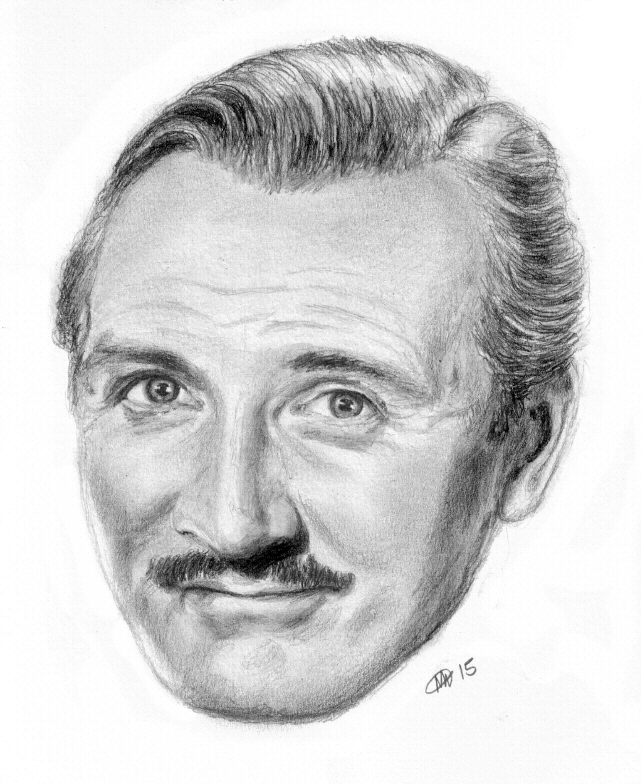
Monday, 30 November 2015

Festival of Film


Also published on my Festival of Britain 1951 blogspot (see link at foot of post)

Before the opening credits of ‘The Magic Box’ (1951), the Festival of Britain logo flashes onto the screen. The film was shown at the Festival, before it went on general release. We can therefore assume that it was meant to fit in with the ethos of the Festival – a celebration of British achievement. It certainly showcases the best of contemporary acting talent, with a long list of stars performing in tiny cameo roles. Some parts are so tiny, it is literally a case of blink and you will miss them.  I certainly missed seeing Googie Withers, Sheila Sim and Marius Goring. Others have slightly more prominent five-minute pieces, giving us a taste of the kind of role that they were famous for. Margaret Rutherford as a bossy yet coquettish dame, Laurence Olivier as an incredulous policeman, Joyce Grenfell as a fussy spinster and Eric Portman as an angry businessman.  I could go on. It is a veritable pageant of drama skills. 


The talent is a literal celebration of British film-making. But the storyline also looks at the life of film pioneer William Friese-Greene (played by Robert Donat).  Fitting in with the Festival’s celebration of British science, it seems to say – ‘Look! It was us that invented film! But we are so modest with our achievements while other nationalities blow their own trumpets so loudly that they drown us out!’

Visit Sarah's Amazon page...click the link below
Having watched the film myself, I wasn’t impressed with the character of Friese-Greene. He is portrayed as a very selfish man, who puts his inventing before his wives and his children. His first wife dies of ill health – the film suggests that this was exacerbated by the debts that her husband ran up by eschewing proper work. He marries again and his six sons are all shown as suffering from his single minded attitude. In the end, three of them join World War One as under age soldiers in order to stop becoming a financial burden on their parents. This second marriage ends when his wife can take no more.  He apparently destroyed the opportunity to become a rich society photographer because of his obsession with developing a moving picture.  I was flabbergasted at this – surely he could have invented at evenings and weekends?  This is how the rest of us have to follow our dreams!


I wonder if the 1951 audience took a different  attitude?  Were they meant to view him with sympathy as a man who gave up everything and got no recognition for his ground breaking work?  This would sit more comfortably with the Festival ethos. Does ‘The Magic Box’ depict a long gone set of values, when it was understandable to put genius before family? When a man could get away more easily with neglecting his sons? A fascinating question of 1950s morals and mores. 


Monday, 9 November 2015

Make Do and Die

Being something of a sewing fan, the wartime catchphrase “make do and mend” makes me immediately think of clothing.  This is what the phrase was often referring to in its everyday use.  Make do with your old clothes, patch them up, transform your curtains into a frock etc.  But then a film that I watched recently broadened my make-do-mend horizons.    The film was called ‘Bang! You’re Dead.’ It was made in 1954 and stars Jack Warner.  Warner plays a woodsman who lives with his seven year old son.  As he works in the woods, his son is left free to roam.  Inevitably, the boy is drawn to an abandoned U.S. military base, where he plays in the huts and on the old jeeps scattered around the yard. One day, while rummaging around his playground, the boy finds a revolver. He uses it to play highwaymen with a man on a bicycle, and unwittingly shoots the cyclist dead.  An innocent man is then accused of murder and the rest of the film is taken up with the investigations.

My “make do and mend” moment concerned the housing depicted in the film. Warner and his son live in a Nissen hut, a large semi-circular, corrugated iron construction. They form a row of such dwellings; the inhabitants having done their best to transform them into cosy cottages.  They keep hens in their gardens, grow their own vegetables and hang out their washing to dry among the bushes and trees.  At a glance, filmed in the summertime, it all looks quite idyllic.  Surely this wouldn’t have been so cosy in the wintertime when the wind howled across bare gardens and through the gaps in the corrugated sheets.  Not really somewhere that you’d want to live all year round.  Possibly these huts depicted in the film were meant to have been connected with the U.S. base.  There were many of these Nissen huts sprouting up throughout World War Two – they were cheap preformed structures that were quick to get into place. They were used in many wartime developments such as military bases and prisoner of war camps. When their original use was no longer necessary, then the “make do and mend” mentality meant that they were often put to varied peacetime uses, from homes to playgrounds to pigsties.

Jack Warner by @aitchteee
Coincidentally, another use for Nissen huts was brought to my attention just a day or two after watching the film.  I work for a charity that supports people who have become ill as a result of asbestos exposure.  I was given a case study of a teacher who had developed Mesothelioma as a result of working in Nissen huts that had been converted into school classrooms.  The insides of the huts had been coated in an asbestos impregnated material.  The pinning and stapling of work to walls had released the deadly fibres into his lungs. Unbeknownst to Jack Warner, those huts on the abandoned base held something more deadly that the abandoned revolver with a single bullet left in it.  This is, of course, aside from other diseases linked to living in damp and unsanitary conditions.  One suspects that the wife and mother of the woodsman and his boy succumbed to pneumonia or something similar.


So it transpires that there were two kinds of “make do and mend”.  A good sort, where materials were looked after, reused and resources preserved.  One that some are now trying to return to in response to our throwaway culture.  But there was a side that we would not want to return to, one which forced people into makeshift homes and workplaces.  We are still feeling the consequences of this.


Follow the History Usherette on Twitter: @Agathadascoyne @SewsAttic @VintageMapLady

Find out more about Asbestos in Schools: @DAST24


Reviews for The History Usherette's Second Seat, Third Row on Amazon:

Thursday, 22 October 2015

Hysterical Historical

To transport people away from the misery of the present day, they need to be taken to an unfamiliar location.  This location can be based on fantasy, or it can be based on history. The historical film was very popular during World War Two.  The opportunity to cocoon oneself at the cinema in a world far removed from the bomb damaged and chaotic one outside was all too tempting.  Possibly the most famous example is Olivier’s Henry V (1944) – a pageant of patriotism delivered as a deliberate morale booster for the war weary. But there were many other films that set out to provide a light slice of escapism via ripped bodices and glossy galloping steeds.

You can always pick out a popular genre in film, because sooner or later somebody will come along and satirise it. The wartime historical escapism film got its satirical version in a film that outstrips them all for sheer entertainment value.  ‘On Approval’ (1944) stars Clive Brook, Googie Withers, Beatrice Lillie and Roland Culver. The story is set in 1890, and concerns two impoverished aristocratic gentlemen exploring the possibility of marriage to two wealthy widows.  There are shades of Oscar Wilde in some of the witty one-liners, while Withers and Lillie are hilariously sharp as two women with modern values living in an old fashioned world.  
Googie Withers by @aitchteee
I can honestly say that this is one of the funniest films that I have ever seen, and I have to thank @MissElvey on Twitter for recommending this to me.  The opening scenes, which serve to introduce the film, are both achingly funny and informative.  These scenes are voiced over by E.V.H. Emmett, that familiar voice from newsreels and Carry on Cleo. We begin with scenes of war, of guns being fired from ships.  Emmett suggests that we leave these behind and go back to 1939, when everyone was enjoying themselves.  Scenes then follow of noisy motorbike races, watersports and a countryside littered by hikers. No so peaceful in 1939 either then was it? Emmett then suggests that we go back even further, to Grandmamma’s day, the 1890s.  A time when ladies dressed demurely and knew their place; a time when entertainment consisted of sing- songs at the piano, needlework and cricket. And so the story begins, with Brook’s Duke of Bristol being invited to a party at his own London townhouse, which he has had to rent out to Withers’ American heiress due to chronic lack of funds.

Why begin the film with this direct comparison between life in the 1940s and the 1890s?  This is where it sets its stall out as a satire. With brilliant use of facial expression and knowing exaggeration, it reminds the audience – who was perhaps only the week before spellbound by Phyllis Calvert in ‘Fanny By Gaslight’ – that the past wasn’t all melodrama. On the whole, we are told, to be a woman in the 1890s was terribly dull.  All the strict social conventions kept everyone trapped in a boring and repetitive life.  The story shows that only the monied people (irrespective of class) had any kind of freedom; but even then they could be held to ransom by servants who morally disapproved of their actions.
Visit Sarah's page on Amazon
Despite its sending up all of the morale boosting historical themed films, there is a hint of it in ‘On Approval’. I found it to be something of a feminist film, patently demonstrating to women just how far they had progressed over the previous 50 years. There seems to be an underlying message to women in the audience that despite war, they now had more control over their lives and more freedom – to express themselves through their leisure and their dress.  “Let us keep moving forward” it hints “away from forces that would stamp on our ability to choose.”


The film was released as preparations were being made for D Day. Surely it must have given viewers a breath of that second wind that they now needed to secure freedom and a better future; to remove the need to look for a past that probably never existed anyway.

Monday, 5 October 2015

Larking About

‘The Navy Lark’ was a radio comedy series of the type that was very popular in the mid 20th century.  Like ‘The Goons’, ‘Round the Horne’, ‘Hancock’s Half Hour’ and many others it was a weekly dose of familiar characters and catchphrases which audiences couldn’t get enough of.   These programmes launched careers back then, and spawned other projects too. Hancock, for example was transferred to television.  It is not so well known that ‘The Navy Lark’ got its own film, which arrived quite early on in its lifetime.   Having seen it, it’s not surprising that it isn’t listed among the classics of British cinema.  But its sheer daftness was enough to brighten up my afternoon – well, how can you not smile at Leslie Phillips?

Well hello!  By @aitchteee
Aside from the fruity Mr Phillips, most of the radio show favourites didn’t make it to the screen – perhaps the actors read the script first! The other screen stars are Cecil Parker and Ronald Shiner – veterans who make up for the lack of Pertwee or Barker. The rather far-fetched storyline is as follows – the Larkees are based on a fictional island in the English Channel.  They are supposed to be clearing the area of World War Two mines; but instead they are taking advantage of the laid-back lifestyle to spend their days fishing, womanising and dealing in black market goods.  All this is put in jeopardy when an ambitious officer in Portsmouth works out that no mines were ever laid in that part of the Channel anyway.  He decides to pay them a visit to begin the process of shutting their operations down. Faced with a future of actual work, the Larkees come up with all kinds of schemes to thwart the plans from Portsmouth. This culminates in a faked native uprising complete with pretend battles.  It’s all harmless fun, and I began musing on just how far-fetched the basic plot was.  The film was made in 1959, 14 years after the end of the war, so I wondered about the idea of having mine detection units still in place.  Surely they’d all been cleared up by then? Was this a daft joke, or a genuine possibility? None of my history books touch on naval warfare, so I turned to the Google search box. 

If any mine clearing units like this were still in place in the 1950s, I could find no trace of them. However, I did find some interesting snippets of information.  Firstly, as late as the mid 1950s, relics of the war at sea were still being cleared away because the UK lent Denmark a minesweeper to go and help clear up their coastline.   Secondly, it would appear that mines dating from the 1940s do still occasionally pose a danger to shipping.  As late as 2007, cross Channel ferry services were disrupted due to the discovery of an old device. These mines were built to withstand stormy seas, and they did move around – so on consideration it is unsurprising that some proved difficult to find and are still primed and ready to go off.

I wouldn’t rely on this film to tell me anything about the navy or the Channel Islands.  But it did send me on a little journey of discovery about how the problems of war didn’t just go away in 1945.


My short story, ‘Amphitrite’ touches on the dismantling of mines on British beaches after World War Two.  It’s available in my book ‘Athene and Other Stories’ on Amazon.

Friday, 25 September 2015

A Matter of Blithe Spirits

Visit my Wordpress site to read my new serial story "A Matter of Blithe Spirits".  Here's the introduction:

Last year, I published a book called The History Usherette’s Second Seat, Third Row.  The starting point for this book was one of my favourite films, ‘A Canterbury Tale’.  This film was released in 1944, towards the end of the Second World War, a time that I am deeply fascinated with.  I wondered about the contemporary audience; how the film affected them and made them feel.  Putting this thought together with the Chaucer’s Canterbury Tales, and a book that I had read about the life of a painting…’Second Seat, Third Row’ began to take shape.  The title refers to a seat in a fictitious cinema somewhere near Waterloo Station.  The book takes a group of people who all sit in this seat and see ‘A Canterbury Tale’ when it is first released, and it tells their stories.  I thoroughly enjoyed writing it.

This has been my most well received book to date, and combined with the fun I had writing it…of course I had to repeat the exercise with another film.  This time I have taken two films, both dealing with another fascinating piece of 1940s history.  ‘Blithe Spirit’ and ‘A Matter of Life and Death’ were both in cinemas in the immediate post war period. Both deal with human spirits and the afterlife. There were other films that looked at this subject, and it is no coincidence.  As 6 years of death and destruction came to an end, of course those that survived were moved to consider what had happened to their loved ones.  Films and stories so often reflect popular thought and ideas and are a fascinating window into their time.

So, here is my new story, ‘A Matter of Blithe Spirits’. I will be publishing it in 4 instalments – a kind of introduction and then 3 mini stories spinning off from it. I have not published this as a book because it is fairly short, and anyway it is for quite a niche audience!  If you have never seen either of these two films, then you will not understand this story.  Go and watch them immediately!  Your life will be much richer for it.   I suspect that most of the readers of ‘Second Seat…’ will “get” this story – and this is a little thank you to all of you for buying my book.  If you haven’t read ‘Second Seat…’ then I hope that this will move you into a purchase!  A link will be given at the bottom of the page.  

Monday, 21 September 2015

The Usherette Takes a Trip With Matt

Welcome to the second guest blog on The History Usherette.  This time, Dr Matt Kerry tells us about a little known 1937 film called ‘Sam Small Leaves Town.’

Matt is an enthusiast of both British cinema and holidays.  He is the author of a book called ‘The Holiday and British Film’ (published by Palgrave Macmillan) and also writes a blog that can be found here: http://drmattkerry.blogspot.co.uk/


Sam Small and Butlin’s, Skegness

'Sam Small Leaves Town' (1937) is a little-seen British film starring Stanley Holloway in the title role – although strictly speaking, Holloway actually plays a character called Richard Manning who masquerades as Sam Small in order to hide at a holiday camp for two weeks as part of a bet. The character of Sam which Holloway invented, had become popular on stage, on records, and in short films from the late 1920s. In his autobiography Holloway claims that ‘there was a time when people used to insist that Sam Small was better known than Stanley Holloway and I’m not arguing about that’ (Holloway and Richards, 1967: 83).


Perhaps it was more than a coincidence that 'Sam Small Leaves Town' was shot at Butlin’s first holiday camp at Skegness a year after it opened. Billy Butlin was firstly a showman, but one with a keen business sense. He knew the importance of good publicity and marketing, bringing stars such as Gracie Fields to pose for publicity shots at the camp (Ward and Hardy, 1986: 58).

Unlike the more raucous representation of Butlin’s at Filey in 'Holiday Camp'* (1947), Butlin’s in the Sam Small film seems much more upmarket. Customers in the film drink champagne, the women in the bar wear long evening gowns, and the dining hall (although supposedly catering for ‘2000 people’ as one character points out to Stanley Holloway) has an atmosphere more like a restaurant, than a canteen.

The holiday camp location and the surrounding countryside are exploited to the full. A musical number built around a cycling excursion is filmed in Lincolnshire’s country lanes, and there are scenes set in the camp’s ballroom and poolside. Holloway leads the campers in the song ‘Penny On The Drum’ to which everyone processes out of the bar and round the Butlin’s pool, with its distinctive fountains.


One interesting aspect of this film is its inclusion of the African American musical comedy performers Brookins and Van, who take part in the stage show in the film’s finale. The characters lend an air of relatively sophisticated American musical entertainment to the film – one plays the piano whilst the other tap dances – although, culturally, they could also arguably represent an Americanisation of holiday attractions which cultural critics of the 1930s and ‘40s found to their distaste.

'Sam Small Leaves Town' is notable for prefiguring the Holidays With Pay Act (1938) by recognising the rights of a decent holiday for the working classes, and also for its representation of a Butlin’s style which as yet was not fully formed. Holloway sings a song that includes the lyrics ‘Hi De Hi, Ho De Ho’, but the semi-sophisticated holiday camp here does not quite match the general perception of the boisterous holiday camps that later films and television programmes like 'Holiday Camp' (1947) and 'Hi De Hi' (1980 – 1988) helped to construct.


Follow us on Twitter: @agathadascoyne @DrMattKerry


Further reading:

 Butlin, Billy, 1982, The Billy Butlin Story, A Showman to the End, London: Robson Books

Holloway, Stanley and Richards, Dick, Wiv a Little Bit o’ Luck, The Life Story of Stanley Holloway, 1967, London: Leslie Frewin

Kerry, Matthew, 2012, The Holiday and British Film, Basingstoke: Palgrave Macmillan

Read, Sue, 1986, Hello Campers! Celebrating 50 Years of Butlin’s, London: Bantam Press

Ward, Colin and Hardy, Dennis, 1986, Goodnight Campers! The History of the British Holiday Camp, London: Mansell Publishing Limited


Thursday, 10 September 2015

Jerry Built George

‘Feather your Nest’ (1937) is an early George Formby film.  As is usual there are a couple of musical interludes in the story.  The main interlude, one that is repeated through the film, is the enduringly famous “Leaning on a Lampost”.  George also sings “When we Feather our Nest” which is an incredibly cheeky song for the time – I can’t quite believe that he got away with those lyrics!

Much of the film is set in a gramophone record factory.  This is a fascinating window on the early popular music industry, showing us how songs were recorded and transferred to a disk for the mass market.  Viewed from the digital age, it’s quite staggering to see how primitive it all used to be.  It appears that this was such a fragile medium too.  The recordings were initially put onto a wax disk.  Like the shellac records that these were then transferred onto, one clumsy slip and the recording was lost forever.  The equipment too was easily broken.  I don’t know if this is just me, but this seems to be the opposite of the modern problem, when it seems virtually impossible to lose a piece of music that you have purchased.

George plays a very clumsy factory dogsbody – every time the factory hooter goes off he drops whatever he happens to be holding (sounds hackneyed but is actually very funny in George’s professional hands). His butterfingers are disastrous for him, as he is in the process of buying and furnishing his first home with fiancée Polly Ward.

Cheeky Formby by @aitchteee
Their new home, which they call The Nest, is the sort of house that I’ve always fancied living in.  It’s one of those 1930s suburban semi-detached semi-timbered jobs with the stained glass sunrise over the front door. Unfortunately, I live with a new house fanatic and since giving up my own little Victorian terrace I have been railroaded into living in new builds.  He says that they are easier to maintain. I despair of the fact that I never have any storage or a decent sized garden.  Modern houses are not built to be actually lived in, I find.  They are built to fill the smallest possible plot and bring in maximum returns for the minimum outlay. Everything fails to work after a while.  We once had a house where it was impossible to clean the bedroom window.  I have nowhere to store my sewing collection and projects – it all lies around on the floor in baskets.  In our current house, we have had to convert the integral garage into a big cupboard, so that there is somewhere to keep the hoover, the wellies and the fruit and veg.  My two-up-two-down terrace was better than that.  I had a lovely walk-in pantry under the stairs and floor-to-ceiling cupboards next to the chimney breasts.  I always thought that one of those 1930s semis would also have been built with more care for those that lived in them.  That shoddy homes were yet another sign of our modern gradual slide back into Medieval living standards. Surely if 1930s builders thought enough to add stained glass and nice arched porches, then the insides would be good too.  

However, one of my favourite twentieth century architecture fans loathed these types of houses. John Betjeman was scathing of these developments and this has always puzzled and saddened me.  Why didn’t he like them? In his 1937 “Town Tours” which he recorded for the BBC he calls them:
Ill-shaped brick horrors
A potential slum that will cost them more in repairs than it ever did in instalments
Sham-Tudor
Jerry-built
He despaired of how they were dumped into the landscape with little thought to the surrounding area.  I just thought that maybe he would have been more kind to them if he saw what was to come at the end of the century.

‘Feather your Nest’ supports some of Betjeman’s views however.  George and his fiancée’s new home has been thrown up by a speculator and it does look to be on the verge of falling down again. The front door knob falls off and bedroom window falls out before they’ve even moved in. All kinds of things go wrong. The builder is depicted as a shady character, concerned only with money and not with building a decent home.  As I have said before, the comedy in these scenes must reflect reality as the audience will laugh at what is familiar to them.  So Betjeman was right.  These houses were often badly built with little concern for anything but profit.  Both mine and George’s illusions were shattered.


Still.  I would like to try living in one, just to see for myself.  Maybe one day I will get my own little Tudorbethan paradise.